Zorluk
A kamu güvenliği authority was tasked with protecting a three-day international summit attended by senior government officials from multiple countries. The venue was a modern convention complex in a major city — surrounded by hotels, commercial towers, and residential buildings, many with direct line-of-sight to the summit’s primary entry points, vehicle staging area, and outdoor delegate movement zones.
The security planning team faced a well-understood but difficult-to-address risk: the surrounding urban environment provided numerous potential observation points, all in public or semi-public space, from which unauthorized observers could establish persistent optical surveillance using commercially available equipment.

Conventional security measures — route surveys, building access control, and perimeter fencing — addressed physical intrusion. However, they did not fully address long-range optical observation from nearby buildings, where high-magnification lenses, cameras, or other optical devices could be used to monitor sensitive movement areas from hundreds of meters away.
Three specific concerns drove the requirement for optical detection capability:
High-risk observation angles. The outdoor vehicle staging area and primary entry walkway were exposed to multiple high-rise viewing angles within 800 m. Advance surveys identified 23 potential elevated observation points across five buildings. Physically monitoring all 23 positions throughout the event was operationally difficult and would have created unnecessary disruption to normal city activity.
Unauthorized information collection. The security team assessed that external observers could attempt photographic or video documentation of delegate arrivals, security arrangements, and vehicle movement patterns. Such information could create future security risks if not detected and managed in real time.
Laser source warning. The security team also required warning capability against unexpected laser emissions in the 1 μm–1.6 μm range, helping operators identify the direction of laser sources during the summit period.
Çözüm
The security authority deployed a layered optical surveillance detection system based on Midradar’s FinderPro series, integrated into the venue’s existing security operations center.
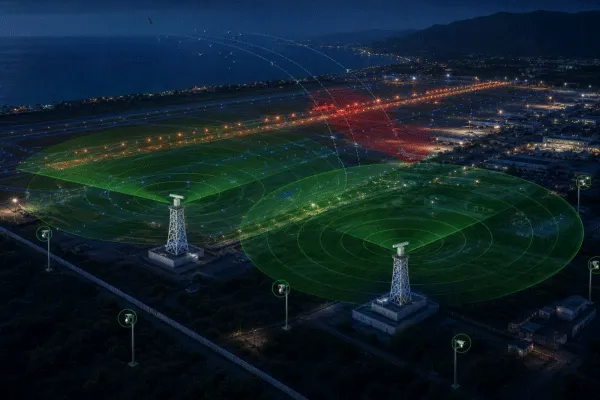
Two FinderPro-X fixed optical detection systems were installed on elevated positions at the northeast and southwest corners of the venue compound, providing overlapping 360° coverage of all approach angles and the surrounding building facades within 2,000 m.
Each unit conducted continuous laser-active scanning at 360°/s, automatically detecting optical instruments oriented toward the protected area and providing azimuth, elevation, and range data to the security operations center within three seconds of detection.
During the summit’s three days of operation, the two units collectively performed over 2.6 million individual scan cycles and processed 847 potential return signatures. Of these, 23 were flagged as confirmed optical instruments with a detection confidence of 95% or above, localized to 14 distinct positions across seven buildings.
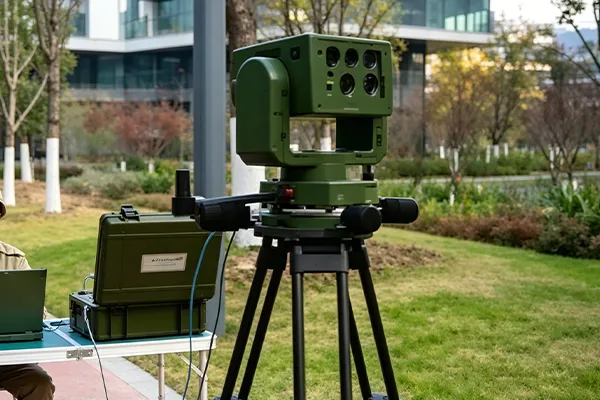
Advance team sweep — FinderPro-P
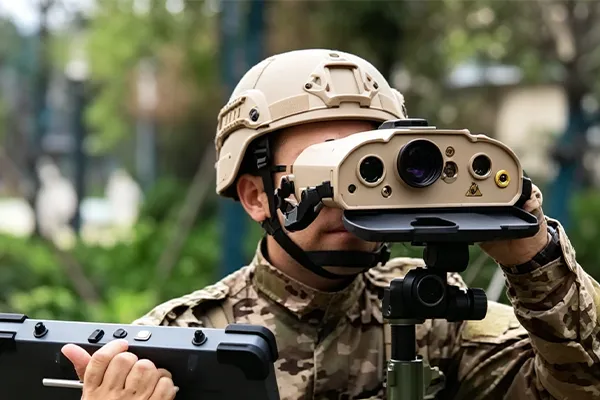
Four FinderPro-P handheld units were issued to advance team personnel operating outside the fixed perimeter. In the 72-hour pre-summit period, advance teams used the FinderPro-P to manually sweep each of the 23 pre-identified elevated observation points, confirm site status, and conduct on-demand scans of newly identified concerns during venue setup operations.
The handheld units’ 1,200 m detection range and ≤2.6 kg operational weight enabled rapid deployment on foot, in vehicles, and from temporary elevated access points — without requiring dedicated infrastructure at each scan location.
Laser warning integration
Both FinderPro-X units were configured with the optional laser warning module, covering the 1 μm–1.6 μm wavelength range with 45° angular resolution. This provided real-time detection and direction-of-arrival data for unexpected laser emissions directed toward the venue during the summit period.
Response workflow
When a suspicious optical device was confirmed, the security operations center followed a two-stage response workflow: first, activate the optical view interruption function to prevent continued observation; second, relay the location information to field personnel for verification and follow-up action.
This workflow supported a non-contact and civilian-adjacent response model suitable for a dense urban environment, while ensuring that suspicious optical activity was detected, located, and handled in a timely manner.
Sonuçlar
Over the three-day summit:
- 23 confirmed optical instruments were detected and geolocated across the surrounding urban environment
- 14 distinct observation positions were identified, including 4 that were not in the pre-survey list
- 0 VIP movement periods were affected by undetected long-range optical surveillance
- 11 optical view interruption activations were executed; all 11 observers subsequently relocated or ceased observation
- 3 instances of potential laser emission were detected by the warning module; all three were traced to commercial laser distance measurement devices used by construction workers
- Advance team sweep coverage reached 100% of the pre-identified positions within 48 hours of deployment
The security director’s post-summit assessment noted that the optical detection capability improved the team’s ability to identify, locate, and respond to suspicious observation activity. The system helped prevent persistent long-range monitoring and provided operators with actionable location data during key event periods.
System Configuration Summary
| Component |
Model |
Role |
| Fixed optical detection system ×2 |
FinderPro-X (MR-CH1500) |
360° perimeter coverage, 2,000 m range |
| Handheld optical detection device ×4 |
FinderPro-P (MR-MH1200) |
Advance team sweeps, on-demand scans |
| Laser warning module |
Optional module on FinderPro-X |
1 μm–1.6 μm laser source detection |
| Optical view interruption |
Integrated function |
Non-contact observation prevention |