Wu Kang | Radar System Specialist | Updated August 20, 2026
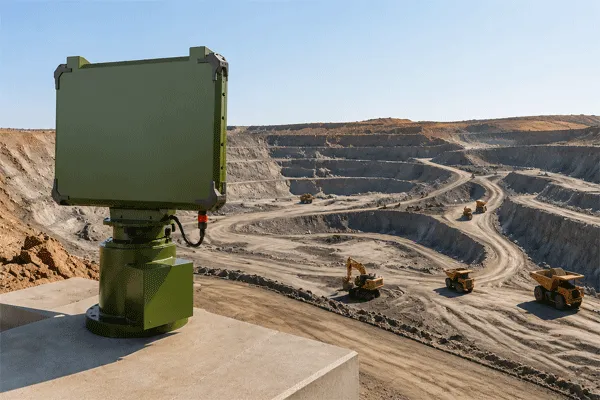
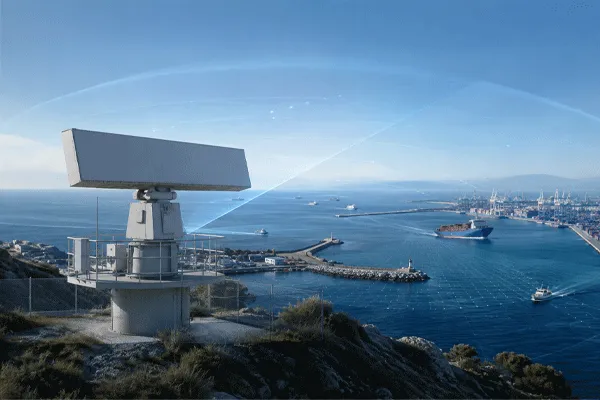
Ground surveillance radar detects personnel, vehicles, and vessels across open terrain, borders, and coastlines using X-band or Ku-band beams and Doppler processing. Range depends heavily on target size: Midradar’s RDG series spans roughly 3 km for personnel up to 50 km for large vessels, set by antenna type, frequency band, and target radar cross-section.
Yer gözetleme radarı: menzil, teknik özellikler ve çalışma prensibi
What a Ground Surveillance Radar Actually Measures
A ground surveillance radar (GSR) sends out a beam, listens for the reflection, and uses the Doppler shift in that reflection to separate a moving target from static clutter — trees, waves, buildings, rain. The system then reports a track: position, speed, heading, and (on newer units) a classification of what the target likely is.
That last part is where procurement conversations usually start. A radar rated to “detect at 25 km” is not making one claim — it’s making three, because a person, a car, and a fishing boat reflect radar energy very differently. Midradar’s RDG series publishes range separately for each of those categories rather than a single headline number, which is the detail worth checking before comparing any two radars on paper.
How the RDG Series Detects and Classifies Targets
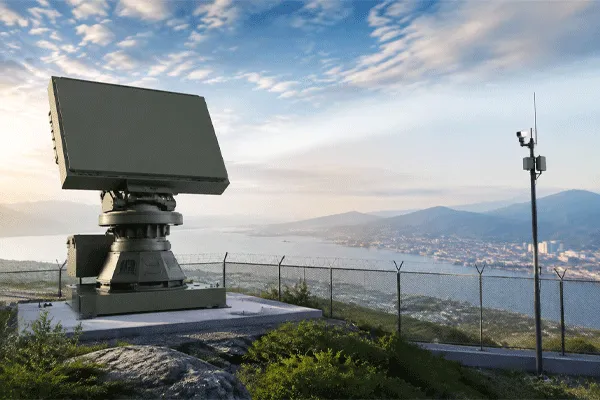
The RDG line uses 1-D AESA (active electronically scanned array) or DBF (digital beamforming) architecture in X-band or Ku-band, depending on model. AESA lets the beam steer electronically instead of mechanically rotating, which is part of why several RDG models hold range accuracy of 5 m or better.
Two processing layers matter for procurement decisions:
- Adaptive clutter suppression filters out recurring background motion — swaying trees, wave action, passing traffic on a road outside the protected zone — before it reaches the tracking stage.
- Track-before-detect (TBD) correlates weak returns across multiple scans, which is what lets a radar hold onto a low-RCS target like a person or a small boat instead of losing it in noise on a single sweep.
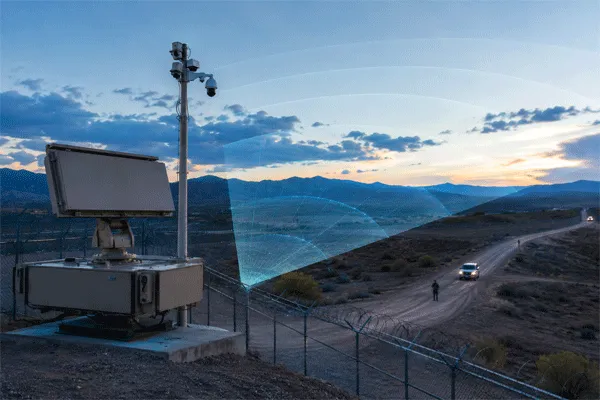
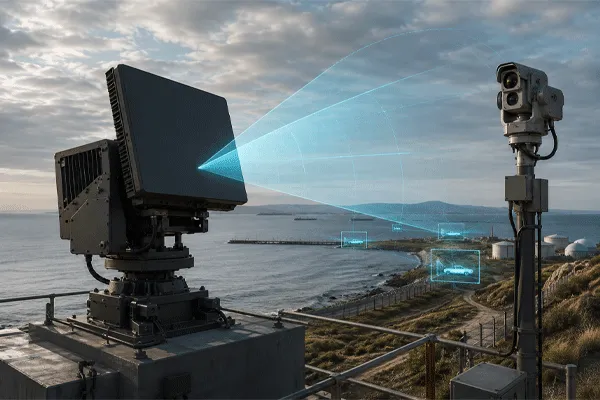
Radar-EO slew-to-cue is a separate integration layer, not a radar-only feature: once the RDG unit has a track, it can hand target bearing to an electro-optical camera so an operator gets visual confirmation instead of a blip on a map. That pairing is common in perimeter and coastal deployments but is a system-level design choice, not something the radar does in isolation.
Detection Range by Target Type
Range figures below come from Midradar’s published RDG datasheets. RCS (radar cross-section) values are noted where the manufacturer specifies them — this matters because “vehicle” and “small boat” are grouped under one figure in most of the line, and the actual object you need to detect may sit above or below that assumption.
| Model |
Band / Architecture |
Large Vessel / General |
Vehicle / Small Boat |
Personel |
Azimuth |
| MR-RDG50K |
X-band, 1-D AESA |
≥50 km |
≥25 km |
≥15 km |
90° (7° elevation) |
| MR-RDG20K |
X-band, 1-D AESA |
≥25 km |
≥15 km |
≥10 km |
95° |
| MR-RDG07K |
X-band AESA, 9.55–9.75 GHz |
≥25 km (RCS 10 m²) |
≥15 km (RCS 5 m²) |
≥10 km (RCS 0.5 m²) |
90° |
| MR-RDG06K |
X-band, compact 1-D AESA |
≥16 km |
≥8 km |
≥5 km |
— |
| MR-RDG03K |
Ku-band, DBF multibeam |
≥10 km |
≥6 km |
≥3 km |
— |
| MR-RDG03-4R |
Ku-band, 4-face DBF |
≥10 km |
≥6 km |
≥3 km |
90°/face, 360° assembled* |
*Midradar’s own product page for the MR-RDG03-4R lists azimuth as 90° in one table and 360° in another, without stating whether the second figure is the four-face assembled system or a per-face value. Ask for the current signed datasheet before using this number in a proposal — it’s the kind of gap that turns into a change order after installation, not before.
Yer gözetleme radarı: menzil, teknik özellikler ve çalışma prensibi
Accuracy, Power, and Environmental Ratings
Range gets the attention, but three other columns decide whether a radar survives a real site:
| Model |
Menzil Doğruluğu |
Açı Doğruluğu |
Track Capacity |
Güç |
IP Rating |
| MR-RDG50K |
≤5 m |
≤0.25° |
≥200 |
≤200 W |
IP67 |
| MR-RDG20K |
≤5 m |
≤0,4° |
≥200 |
≤140 W |
IP67 |
| MR-RDG07K |
≤5 m |
≤0,4° |
≥200 |
20 W transmit / ≤140 W total |
IP67 |
| MR-RDG06K |
Not published |
Not published |
Not published |
≤75 W |
IP67 |
| MR-RDG03K |
Not published |
Not published |
≥100 |
≤85 W |
IP67 |
| MR-RDG03-4R |
Not published |
Not published |
Not published |
Not published |
Not published |
All RDG models share a company-wide operating range of -40°C to +55°C. The MR-RDG06K also publishes a blind zone of ≤50 m and a unit weight of ≤5 kg — figures the other five models in the line don’t disclose on their public pages, which matters if your site has a dead zone right at the base of the mast or a weight limit on the mounting structure.
Choosing a Model for Your Site: A Working Method
- Map the perimeter or coastline distance you need covered, then match it against the “large vessel / general” column, not the personnel column — that’s the figure vendors usually lead with, and it overstates what you’ll get on a human-sized target.
- Identify your smallest target class.If personnel detection at the fence line is the actual requirement, filter on the personnel-range column first and treat everything else as secondary.
- Check azimuth coverage against your mounting plan.A 90–95° radar needs multiple units or a rotating mount for full-perimeter coverage; four-face DBF units are built for wider coverage from one mast, but confirm the per-face vs. assembled figure as noted above.
- Confirm power budget against your site’s DC or solar supply, especially for remote coastal or border masts where a 200 W draw versus a 75 W draw changes your panel and battery sizing.
- Request the specific certification and blind-zone figures your model is missingfrom Midradar directly — the public datasheets don’t carry per-model certificate numbers or blind-zone data for most of the line, so this step isn’t optional if a bid requires it.
A Common Mistake: Comparing One Range Number Across Vendors
Procurement teams often shortlist radars by lining up a single “max range” figure from each vendor’s homepage. That comparison breaks down for two reasons. First, published maximum ranges are frequently a single flagship figure rather than a per-target breakdown — one long-range system markets a flat <cite index=”4-1″>45 km detection distance for land, sea, and aerial targets combined</cite>, while another vendor’s line advertises <cite index=”5-1″>a 20 km to 80 km band covering both ground and low-flying aerial targets together</cite> without separating personnel from vehicles. Second, range itself is not a fixed property of the radar — it scales with antenna height and target size the way a taller vantage point extends line of sight, so <cite index=”6-1″>a radar with a roughly three-meter antenna might detect a truck at seven kilometers but fail to pick up a person at the same distance because of the size difference</cite>. Compared with that kind of single-figure marketing, the RDG series’ practice of publishing separate ranges for large vessel, vehicle/small boat, and personnel targets is the more useful starting point for an apples-to-apples shortlist — but it still needs the RCS assumption behind each number, which only the MR-RDG07K states explicitly on its public page.
Foliage, buildings, and terrain along the line of sight remain a separate problem that no range spec captures: clutter and false alarms from obstructions are a known limitation across ground surveillance radar generally, not a Midradar-specific one, and adaptive clutter suppression reduces but does not eliminate that effect.
Yer gözetleme radarı: menzil, teknik özellikler ve çalışma prensibi
Integration: Protocols and Platform Connectivity
RDG-series radars connect through GB/T 28181 and ONVIF for video/security platform integration, plus RTSP streaming, RESTful APIs, and SDKs for custom software work. If you’re bidding this into an existing VMS, command-and-control platform, or access control system, the integration question isn’t whether it connects — GB/T 28181 and ONVIF are widely supported protocols in the security industry — it’s which specific fields (track ID, classification confidence, GPS coordinates) your target platform actually consumes from the radar’s data stream. That’s a conversation to have with the platform vendor and Midradar together, not something either side can answer alone.
Trade-offs Worth Weighing Before You Spec It
The RDG line’s strength is the per-target-type range breakdown most competitors don’t publish, plus a shared -40°C to +55°C rating and IP67 housing across the models that disclose it. The gaps are specific enough to plan around rather than vague enough to dismiss: three of the six models (MR-RDG06K, MR-RDG03K, MR-RDG03-4R) don’t publish range accuracy, angle accuracy, or track capacity on their public pages, the MR-RDG03-4R has a documented azimuth ambiguity between two of its own spec tables, and none of the six list a per-model certification number — only the company-level ISO 9001:2015, CE, and National High-Tech Enterprise designations are public. None of that blocks a deployment, but it does mean the missing numbers need to come from a signed datasheet or direct quote request before they go into a bid, not from the product page alone.
SSS
What's the difference between AESA and DBF in this product line?
AESA (active electronically scanned array) steers the beam electronically and is used in the X-band RDG models (RDG50K, RDG20K, RDG07K, RDG06K). DBF (digital beamforming) forms multiple simultaneous beams digitally and is used in the Ku-band models (RDG03K, RDG03-4R). Both avoid mechanical rotation, but they trade off differently on range versus refresh rate — the DBF models publish a faster refresh (≤0.25 s / 4 Hz) at shorter range.
Does a higher range number mean the radar will detect a person at that distance?
No. Every RDG model's top range figure is for large vessels or "general" targets, not personnel. Check the personnel-specific column, which typically runs 30–40% of the large-vessel figure across this line.
Can one RDG unit cover a full 360° perimeter?
Single-face models cover 90–95° azimuth, so full coverage needs multiple units or a rotating mount. The four-face MR-RDG03-4R is built for wider coverage from one mast, but confirm whether its published azimuth figure is per-face or system-assembled before specifying it for a full-perimeter job.
What certifications does Midradar hold?
ISO 9001:2015 quality management certification, CE marking, and National High-Tech Enterprise designation, all at the company level. Per-model certificate numbers for the RDG series aren't published on public product pages.
How do I connect an RDG radar to an existing VMS or command platform?
Through GB/T 28181, ONVIF, or RTSP for video/platform-level integration, or RESTful APIs and SDKs for custom integration work. Confirm which data fields your specific platform needs before finalizing the interface spec.














 14:45
14:45